
Heat Pump Installation in Extreme Cold: System Architecture and Thermal Balance
Evaluating Heating Upgrades for Severe Winter Conditions
Your current furnace is struggling to keep up with the deep chill of winter, and you know a replacement is looming, which means you need reliable options comparisons for homeowners that look past basic marketing and focus on actual performance. Edmonton's deep winter freezes (-30°C and below) put immense stress on standard HVAC equipment. For decades, the default solution has been a direct swap of one natural gas furnace for another. Today, however, advancements in cold-climate heat pump technology have introduced new possibilities, forcing homeowners to evaluate whether a heat pump can fully replace traditional gas heating.
When you are exploring modern heating systems, securing a professional heat pump installation ensures your home stays warm no matter how low the temperature drops.
Modern heating requires careful architectural planning rather than direct one-to-one replacements. The primary challenge is understanding how sub-zero performance affects different mechanical systems. A standard heat pump that works perfectly in mild coastal climates will fail to extract sufficient heat during a Northern Alberta cold snap. This creates a highly technical decision point: should you choose a standalone cold-climate heat pump, stick with a high-efficiency gas furnace, or bridge the gap with a hybrid dual-fuel system? Making this choice requires looking past the equipment's brand name and diving into the physics of how your home loses and gains heat.
Understanding the Thermal Balance Point
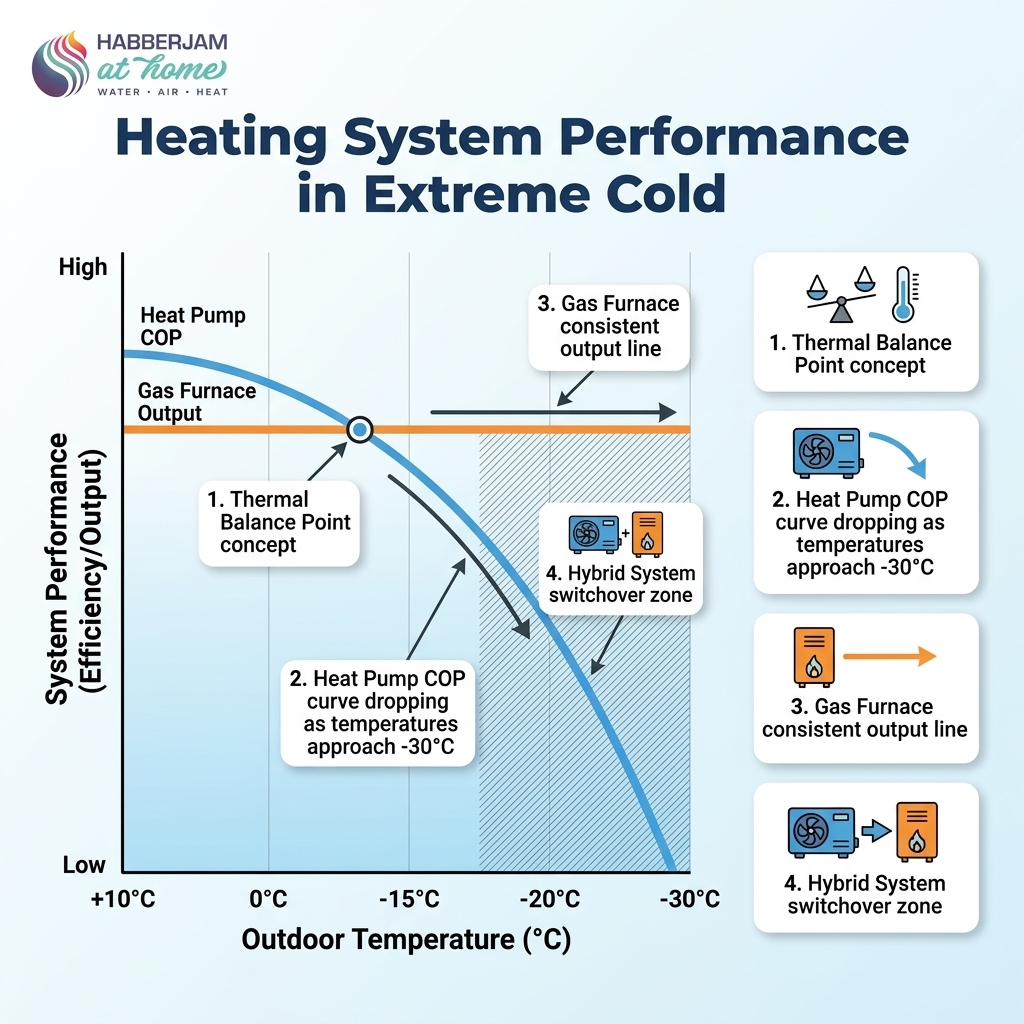
The most critical metric in evaluating a cold-climate heat pump is the thermal balance point. This is the exact temperature where a heat pump's maximum heat output perfectly matches your home's total heat loss. Above this temperature, the heat pump can comfortably warm your home on its own. Below this temperature, the system can no longer keep up with the heat escaping through your walls and windows, making a supplemental or backup heating source physically necessary.
To understand why this happens, we have to look at the physics of heat extraction. Heat pumps do not generate heat by burning fuel; they move ambient thermal energy from the outside air into your home. Even in freezing weather, there is thermal energy in the air. However, as the outdoor temperature plummets, that heat becomes harder to extract and compress. Habberjam At Home's expertise in precisely calculating thermal balance points tailored specifically for Alberta's harsh winters ensures that systems are designed to handle these exact limitations.
How COP (Coefficient of Performance) Impacts Heating
The efficiency of a heat pump is measured by its Coefficient of Performance (COP). This is the ratio of heat output to electrical energy input. Here is how that plays out as temperatures drop:
1. The Baseline Efficiency: At 10°C, a high-quality heat pump might have a COP of 3.0 or 4.0, meaning it produces three to four units of heat for every one unit of electricity it consumes. This makes it incredibly efficient compared to a gas furnace.
2. The COP Drop-Off: As temperatures approach -30°C, the compressor has to work significantly harder to extract trace amounts of thermal energy. The COP curve drops steeply. Eventually, the COP nears 1.0, meaning the system is using as much electrical energy as it is producing in heat—essentially acting like a giant electric space heater.
3. The Switchover Threshold: When the COP drops too low, or when the outdoor temperature falls below the thermal balance point, backup heating becomes necessary to maintain indoor comfort and prevent the system from running continuously without satisfying the thermostat.
Your home's building envelope directly shifts this thermal balance point. A highly insulated home with triple-pane windows loses heat slowly, meaning the heat pump can maintain comfort at much lower outdoor temperatures. A drafty, older home loses heat rapidly, pushing the thermal balance point higher and requiring backup heat much sooner.
System Architecture: Cold-Climate Heat Pumps vs. Traditional Furnaces
Providing an objective architectural comparison of standalone systems reveals significant mechanical differences between traditional natural gas furnaces and modern heat pumps. Cold-climate specific models utilize advanced variable-speed compressors and specialized refrigerants to operate efficiently at lower temperatures than standard models. While a gas furnace relies on combustion, a heat pump relies on phase changes in refrigerant gas.
• Heat Generation Method — Cold-Climate Heat Pump: Extracts and compresses ambient outdoor thermal energy. — High-Efficiency Gas Furnace: Combusts natural gas to heat a metallic heat exchanger.
• Extreme Cold (-30°C) Performance — Cold-Climate Heat Pump: Capacity drops; requires supplemental electric or gas backup. — High-Efficiency Gas Furnace: Maintains consistent, high-capacity heat output regardless of weather.
• Airflow Temperature — Cold-Climate Heat Pump: Delivers a steady, lower-temperature airflow over longer cycles. — High-Efficiency Gas Furnace: Delivers short, intense blasts of highly heated air.
• Infrastructure Requirements — Cold-Climate Heat Pump: Requires an outdoor compressor unit and indoor air handler. — High-Efficiency Gas Furnace: Requires gas lines, proper venting/exhaust, and indoor space.
• Zoning Capability — Cold-Climate Heat Pump: Highly adaptable, especially when integrated with ductless units. — High-Efficiency Gas Furnace: Requires complex damper systems to achieve true room-by-room zoning.
Zoning capabilities are a major differentiator. Many homeowners integrate specific room solutions to supplement central heating, utilizing ductless mini split systems to target stubborn cold spots in additions or upper floors without overhauling their primary ductwork.
Assessing Existing Infrastructure
Evaluating your home's existing infrastructure is critical before moving away from forced-air gas. In one local case, a homeowner needed to replace a furnace originally installed in 1974. The property featured unconventional ductwork that required a thorough mechanical assessment before proposing a modern, high-efficiency solution that ultimately exceeded expectations. This same level of rigorous assessment is necessary when transitioning to a heat pump.
• Ductwork Sizing: Because heat pumps deliver a higher volume of slightly cooler air compared to the blistering hot air of a gas furnace, existing ductwork must be sized appropriately to handle the increased airflow without excessive noise or static pressure.
• Electrical Panel Capacity: Transitioning away from gas completely often requires heavy-duty electrical heating elements for backup, which may necessitate a costly electrical panel upgrade.
• Space Considerations: Indoor air handlers and indoor coils require specific clearances that may differ from your old furnace footprint.
The Hybrid Solution: Dual-Fuel Heating Systems
For many Northern Alberta residents, the most practical architectural solution is a dual-fuel heating system, commonly known as a hybrid system. This configuration combines a cold-climate heat pump with a high-efficiency gas furnace, offering the best characteristics of both technologies.
A dual-fuel system operates through an automated switchover process managed by a smart thermostat. During moderate winter days, fall, and spring, the system uses the heat pump to efficiently warm the home. Because the heat pump operates at a high Coefficient of Performance during these milder temperatures, it uses far less energy than burning fossil fuels. However, when Edmonton's deep winter freezes (-30°C and below) arrive and the outdoor temperature drops below the home's thermal balance point, the system automatically shuts down the heat pump and ignites the gas furnace.
This configuration maximizes energy efficiency while providing total peace of mind during severe cold snaps. You never have to worry about the heat pump struggling to extract warmth from -35°C air, because the gas furnace takes over seamlessly. If you are looking to upgrade your home's resilience, partnering with experienced Edmonton HVAC services ensures the switchover point is calibrated perfectly to your home's specific heat loss profile.
The role of the smart thermostat in this setup cannot be overstated. It acts as the brain of the operation, monitoring outdoor ambient sensors and indoor temperature trends to calculate the exact moment when running the gas furnace becomes more efficient or necessary than running the heat pump.
Energy Efficiency and Long-Term Operational Performance
Analyzing the energy consumption differences between heating systems requires looking at efficiency curves over an entire year, not just during the coldest week of February. When a heat pump operates at a COP of 2.0 or higher, it is generally more energy-efficient than burning natural gas. By reducing reliance on fossil fuels during the long shoulder seasons (fall and spring), a heat pump significantly offsets the overall energy profile of the home.
During these shoulder seasons, a heat pump can easily maintain a COP of 3.0 or better. This means that for the majority of the heating season, your system is operating at peak efficiency. The gas furnace in a hybrid setup is essentially held in reserve for only the most extreme weather conditions.
The Importance of Manual J Calculations:
Proper sizing is critical for long-term operational performance. A system must be sized using rigorous Manual J calculations, which measure your home's square footage, insulation values, window types, and sun exposure.
• Oversized systems: Will short-cycle, turning on and off rapidly. This wears out the compressor prematurely and fails to properly dehumidify the air.
• Undersized systems: Will run continuously, driving up electrical consumption and failing to reach the set temperature on cold days.
Homeowners upgrading their systems may qualify for general government or utility incentives. We advise readers to verify current programs with their utility provider, as stacking energy rebates in Alberta can often offset the initial investment of high-efficiency equipment. Always consult a tax professional or utility representative to confirm current eligibility requirements.
Installation Considerations for Northern Climates
Installing a heat pump in a snowy, freezing environment requires specific physical accommodations that differ vastly from installations in milder climates. Weaving in the reality of drifting snow and ice accumulation in Northern Alberta is necessary to justify these specific installation steps.
1. Elevating the Outdoor Unit: The outdoor compressor must be elevated above the anticipated snow line. This is typically achieved using heavy-duty snow stands or specialized wall brackets. If a heat pump is buried in a snowdrift, airflow is completely blocked, and the system cannot extract thermal energy.
2. Managing the Defrost Cycle: In freezing weather, ambient moisture freezes onto the outdoor coil. Heat pumps enter a periodic "defrost cycle," temporarily reversing their operation to melt this ice buildup. Proper drainage for this runoff is critical. If the water simply drips onto a concrete pad, it will freeze into a solid block of ice, eventually encasing the unit and causing severe mechanical damage.
3. Installing Wind Baffles: Prevailing winter winds can strip heat away from the outdoor coil faster than the system can operate. Protective placement or the installation of wind baffles shields the unit, allowing the defrost cycle to work efficiently and preventing the fan motor from fighting extreme gusts.
4. Specialized Commissioning: Cold-weather refrigerant charging requires specialized technicians. During a harsh winter stretch, one customer reached out for general heating and cooling help and received expert, sincere assistance to get their system optimized for the freezing conditions. This highlights why you need technicians who understand the nuances of sub-zero system commissioning, rather than standard summer AC installations.
Frequently Asked Questions About Cold Climate Heat Pumps
Do heat pumps work in -30 weather?
Yes, cold-climate heat pumps are designed to operate in temperatures as low as -30°C, but their capacity is significantly reduced. While the compressor continues to run and extract heat, the output is rarely enough to warm an entire home without help. In these extreme temperatures, a backup heating source (either electric resistance strips or a gas furnace) is required to maintain indoor comfort.
At what temperature does a heat pump lose efficiency?
A heat pump begins to see a gradual drop in its Coefficient of Performance (COP) as temperatures dip below freezing. Significant efficiency loss typically occurs around -15°C to -20°C, depending on the specific make and model. At this threshold, the system consumes more electricity to extract a diminishing amount of ambient heat.
Do I need a backup furnace with a heat pump in Canada?
For most homes in Northern Canada, a backup heating source is physically necessary. Whether you use a high-efficiency gas furnace in a dual-fuel setup or heavy-duty electric resistance coils inside the air handler, you need a secondary heat source to bridge the gap when temperatures fall below your home's thermal balance point.
What is a dual-fuel heat pump?
A dual-fuel heat pump, or hybrid system, pairs an electric heat pump with a traditional gas furnace. The heat pump handles the heating during mild and moderately cold weather, while the gas furnace automatically takes over during deep winter freezes. This setup optimizes both energy efficiency and extreme-weather reliability.
Is a heat pump better than a gas furnace in Canada?
Neither system is universally "better"; they serve different architectural needs. A heat pump is far more energy-efficient during the spring, fall, and mild winter days, while a gas furnace provides unmatched, high-capacity heat during extreme cold snaps. Combining both in a hybrid system is often the most effective strategy for Canadian climates.
How does a heat pump defrost in freezing temperatures?
A heat pump defrosts by temporarily reversing its refrigerant flow, essentially switching into air conditioning mode for a few minutes. This sends hot refrigerant to the outdoor coil, melting accumulated frost and ice. The system then drains the water away before switching back to heating mode.
Making an Informed Decision on Your Home Heating Upgrade
Choosing the right heating system for severe winter conditions depends entirely on your home's thermal balance point, existing ductwork, and electrical infrastructure. Extreme cold requires specific architectural planning to ensure you are never left without adequate heat when the temperature drops to -30°C. Whether you opt for a standalone cold-climate unit with electric backup or a robust hybrid dual-fuel system, the engineering behind the installation matters just as much as the equipment itself.
A clear, technically sound comparison of how each system performs in extreme cold is the first step. To ensure your home is equipped for the realities of Northern Alberta winters, we encourage you to seek a professional assessment. A thorough evaluation of your property's heat loss profile will provide the concrete data needed to make a confident, long-lasting upgrade.

Customer Testimonials
Hear from satisfied customers who trust us for reliable HVAC and plumbing service across Edmonton



Customer Testimonials
Hear from satisfied customers who trust us for reliable HVAC and plumbing service across Wichita.
Service Areas